Sunday, January 31, 2016

Viktor Frankl

Deutsch: Viktor Frankl
Deutsch: Viktor Frankl (Photo credit: Wikipedia)
Viktor Frankl,  b. 26 March 1905 – d. 2 September 1997, the second child of Gabriel and Elsa Frankl of Vienna, Austria. He told his parents when he was a small child that he would become a doctor. He was a brilliant student and when he was still a medical student between 1928 and 1930, he organized a program to provide counselling to high school students at the time they received their report cards. No students committed suicide that year. He received some acclaim for the success of the program. Between 1933 and 1937 he completed his residency in neurology and psychiatry at the Steinhof Psychiatric Hospital in Vienna where he was responsible for the Suicide Pavilion and he treated 30,000 women with suicidal tendencies. In 1938 he established a private practice.
In 1941 he was married to Tilly Grosser. 
 In 1942 He and his family were sent to Theresientsadt Ghettos where he practiced medicine for a while. Later they were all sent to prison camps.  Viktor went to Auschwitz prison camps where he treated other prisoners for a while. Tilly was killed in Bergen Belsen. His father died before they left Theresienstadt. His mother Elsa and his brother Walter died in Auschwitz. His sister Stella emigrated to Australia from Austria. He was sent to one camp associated with Dachau where he was part of a slave labor group. In 1945 he was sent to a so-called rest camp called Türkheim, affiliated with Dachau. He was liberated there by American soldiers on the 27 of April 1945. Through these events he formulated the framework of Logotherapy in which he learned to find meaning in the horrors he had faced and spent the rest of his life teaching others to do to. He married Eleonore Katharina Schwindt in 1947 and they had one daughter who became a child psychologist. He wrote several books and lectured and practiced widely until his death in 1997.


Wednesday, January 27, 2016

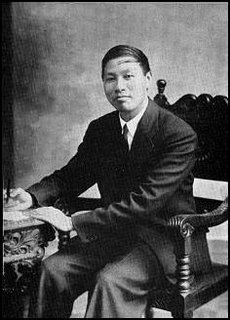
Watchman Nee

English: Photo of Watchman Nee 中文: 倪柝聲的照片
English: Photo of Watchman Nee 中文: 倪柝聲的照片 (Photo credit: Wikipedia)
Watchman Nee (November 4, 1903 – May 30, 1972) Chinese Christian who became a leader in the Church in China by beginning the use of homes for meeting. He started the home meetings in the 1920s when he was only 17. He was the ninth child of a second generation Christian family in Foochow China. He had been dedicated to the Lord by his mother before his birth. He was exceptionally intelligent and excelled in school graduating from Anglican Trinity College but he did not attend theology school gaining his extensive knowledge by reading widely while practicing dedicated spiritual exercises. In the early years he divided his money into three classes: one third he spent on his own needs, one third he gave to help others and one third he used for the purchase of books. He accumulated three thousand volumes over his lifetime. He had an unusual ability to glean facts and retain information from reading. He also exhibited determination in learning to apply spiritual truths. 

When he was a teenager he fell in love with Charity Chang,the daughter of an old family friend. She was not a Christian at the time and ridiculed Jesus in Watchman’s presence. He struggled with it but decided to end their relationship. Ten years later after she had completed college she attended meeting in Shanghai. She had become a Christian and during one of his conferences, they were married. He suffered greatly with chronic illnesses through which she attended him.

His ministry began in personal study to understand and practice the  consecrated life, and his vision was for home churches to become 
true unity of spirits. He rejected the denominational boundaries he felt were detrimental to spiritual unity. He traveled to the United States and England, but his mission was directed toward China. 
After his marriage Charity nursed and support him during his frequent illnesses. He suffered for about ten years with Tuberculosis and later with a severe stomach disorder and very painful angina pectoris.

In 1942 he left his ministry to help his brother’s failing business. 

By 1948 he turned the business over to the church and resumed his 

ministry again. In 1949 the Communist Party gained control in 

China and the Christian Church came under severe persecution. He 

was arrested in 1956 and accused of many false crimes including 

tax evasion, bribery, and cheating on government contracts. He 

spent the last twenty years of his life in prison. Only Charity was

allowed to visit him. Charity died in 1971 and he followed her in 

May of 1972.

His writings continue to inspire Christians all over the world. His 

grandniece was given access to a note left under his pillow which 

she memorized and reported. She said it was written in a large unsteady hand. It said: Christ is the Son of God who died for the redemption of sinners and resurrected after three 
days. This is the greatest truth in the universe. I die because of 
my belief in Christ. Watchman Nee."

This information was gleaned from Wikipedia.

Saturday, January 16, 2016

Assuming God

      When my mother once fell down the steps at the front of the Methodist Church she had attended all her life, she swore, piteously from her reclining posture on the couch, she would never go again, but she lied. When I was about nine I made a profession of faith and joined the Church on Palm Sunday morning, and when I looked behind me she was there being supportive, though tearful.


      (This is the United Methodist Church in Bogata, Texas. The ramp on the left side has been added since I grew up.)
     I won't say I never had a crisis of faith, but I never rebelled in any significant way. I just always assumed that God was real and I was a Christian from that time on.  
     Since then I have born 6 children, loved and lost a husband, earned a degree, and worked in the Texas Prison System as a psychologist, and now I can say without reservation, I believe in God as my Father and the source my life, and Jesus as my Lord, my Savior, my Rock, and my Redeemer. During this process I have had many challenges to my faith, but I never lost my deep respect and reverence for God.
     Over the years and challenges to my faith, I have explored the questions about God's existence and found nothing in them to replace my faith and the peace it brings me. I have read C. S. Lewis's books and writings for many years. I have examined some of his works in regard to belief in God. One thing that impressed me about Lewis is that he was a highly educated man who was an atheist who became a Christian after 30 years of age. 
Then I read about Albert Einstein who, even though he was a world renowned theoretical physicist, was still a believer in God. These two brilliant scholars both found reason to believe in an invisible God in the face of much argument not to. 
     One thing seemed obvious to me: Believing in God has little to do with reason or argument. Building a beautiful argument to believe is a sterile and lifeless discipline if you are doing it as just a parlor trick. Believing in God extends beyond the limits of physical and astronomical bounds. It is born in the depths of the soul and draws on more than we have the capacity to understand, so it may be useless to appeal to the mortal mind. But that is a place to begin. Read the Bible, listen to the sermons, watch life unfold in people around, view joys and disasters, and see for yourself where God is and what He is doing.
     

Tuesday, January 12, 2016

On Choosing a Subject

I love to write. I love the power and challenge of transforming my ideas and knowledge and experience to a form that can be shared with others. Sometimes I think I'm arrogant to think that anyone wants to read my stuff, but then I remember that maybe it's a thought they had not considered before. Maybe I'm obligated to share my thoughts with the universe. There goes that arrogance again.

It's fun to engage in struggle to say things the way you want to. And sometimes it's very hard. I really like the short, succinct, and sometimes memorable quotes, but they are usually reserved for Winston Churchill or Emily Dickinson. But still I try. 

The hardest part of writing is finding a subject and an approach that I can feel confident about. First I have to have an opinion about the subject or something to say. If the subject is something that is talked about a lot or is a controversial subject in society, maybe it's easier. In this case the opinion may form quickly without great effort, but there may be many views of the controversy and I may have to examine my own bias before I can form an opinion. 

I have found that many things that are legal and common in our society are, by my conscience, highly objectionable. To protest practices and ideas that are already accepted by society may be the best way to instant oblivion for a writer. On the other hand, if the writer can be persuasive, it may be the avenue of change. "The Muckrakers" brought about change by exposing deplorable conditions and practices even though they suffered some personal threats and challenges to their careers. In the long run, it made some of them famous. Maybe I just need to dig a little deeper.

Wednesday, December 2, 2015

I Thessalonians 5:18--In Everything Give Thanks

One year, before Thanksgiving, I learned the meaning of giving thanks in everything. The verse doesn't say "Give thanks for everything." It only says to "give thanks in everything." Give thanks in whatever situation you find yourself. Give thanks when the light turns green, but give thanks when it turns red, too. In favorable situations we should give thanks to God and in tragic situations we are still required to give thanks. Bad things happen. I don't feel thankful for them. I had learned that I wasn't giving thanks for the situation, but God's intent for me was that I should give thanks. Everywhere in whatever season and whatever weather. God required me to give thanks to him. My feelings are not the focus of my thankfulness, but God's sovereignty is.

I'm thankful when I realize this is not my problem and God has a better plan that I have. My girls were old enough to memorize and I required them to learn this verse. I called it "the rule." When something happened that overwhelmed me, and I couldn't express thankfulness to God, I would say, "Somebody say the rule." One of them would repeat the verse out loud. Hearing it in real time in the midst of the event would refocus my faith, and suddenly the horrible was just inconvenient. I had another child after this had become my practice. As soon as she was old enough to know her name, she was indoctrinated, and she also became a prod to my conscience and faith.


After some years, I don't remember how many, I read the passage and continued to verse 19. I was astonished that the letters vibrated on the page. It said, "Quench not the Spirit." Boy sometimes the Word really speaks to you. I re-read the passage beginning at verse 16 Rejoice evermore. 17 Pray without ceasing. 18 In everything give thanks, for this is the will of God in Christ concerning you. 19 Quench not the Spirit. I read it again. Quench means to pour water on the fire. Don't act in ways that prevent God's Spirit from being active and alive in your situation, especially when it is a bad one. When we accept the facts as they really present themselves and recognize God's power and majesty, our faith is released for God to take action. When we whine and complain, we restrict God's freedom to act on our behalf. "Quench not the Spirit" became a corollary to The Rule, 1 Thessalonians 5:18. I find it very faith-building to read this whole section often. You may find other points and phrases that spur you on to obedience and faith in your journey with Christ. Underline them or keep a journal. Memorize them. They will sustain you in hard times. Sometimes they may be a bridge to a testimony.

Friday, November 6, 2015

Christmas Rant

The parade of sappy love stories that masquerade as Christmas TV has started. I go though this every year, and repetition does not make it better. There are a few TV shows that are repeated every year that have become a tradition: A Charlie Brown Christmas,  A Christmas Story, Home Alone, It's a Wonderful Life, and A Christmas Carol have become staples in our Christmas viewing experience at my house. Please notice than none of these are love stories. Some of them are humorous, and some are just rousing good stories set in a Christmas background. Some actually depend on acting! It's hard to beat Jimmy Stewart and Darren McGavin. Some of the other actors in these classic films are excellent too. Macaulay Culkin as Kevin endears himself to me every year. The crooks and the family were all funny and afforded Kevin revenge and triumph. However enjoyable these films are or funny or traditional, they don't match the meaning of the birth of a Savior so it's really hopeless to find the meaning of Christmas in a film made for commerce, even a good one.

I guess I'm not very fashion conscious. The new trends don't impress me much. Lime green and fuchsia don't strike me as Christmas colors. Getting drunk does't do much for me either.  I'm more into reading the Bible story that started it all and cooking dinner and having family to love and laugh with. I like Christmas Eve Communion and candlelight; I like hymns and fruit cake and boiled custard.(I can give you the recipe.) 

The Christmas Story reminds me of tragedy and sacrifice. Not all the elements of the first Christmas are celebrated or re-enacted. Three of my children were born Christmas week, but I didn't go to the barn to have a one of them, and we had a barn. Modern thought has romanticized the barn until it isn't even a threat to the life of the child that was born there. Now they talk about soft hay, and warmth, and safety. Hay is not soft. I had a barn and I know. Barns are smelly, dusty, unfitted for having a baby.

For Christmas this year I want to recognize the sacrifices that make this season a joy and the glories that resonate in my soul when I remember that the Baby Jesus grew up to be the Savior of the world. There is more to Christmas than tinsel and frivolity. There is glory and love never-ceasing. Read Matthew 1:18-2:23 and Luke 2:1-38.


Saturday, October 24, 2015

Walk in the Rain

The Rain People
The Rain People (Photo credit: Wikipedia)
We now have the reports of Hurricane Patricia and the resultant rain. I love it! TV reception is poor and continues to be interrupted by the dense cloud cover. I love the splatter and dripping from the roof and trees. It's Autumn and this is Awesome. I love the atmosphere when there is rain and clouds, dripping and puddles. I'll read Robert Frost's "My November Guest" this evening and share his appreciation of the day. I'm sure some people are almost overwhelmed by it, but I'll take them on - one at a time or en mass.

This is a day to prepare for what comes next. Rain prepares the earth for a new crop. Rain insures new growth, and flowers, and harvest. It's not time yet, but it won't come without the rain first. It might take a year, but some time to consider is included in the wait.
While we wait, we plan what to plant. We envision the layout of a garden, or orchard, or project. While we wait, we build our strength to do the work, chose our tools, buy our seed. There is a lot to do during the rainy season.

I walked over to pick up the mail in the rain. Walking in it gives a new perspective on rain. The jacket shed most of the water, but my back still felt the chill of it, and my hair dripped, and my glasses are smeared with drops. Frost was right: "My sorrow when she's here with me thinks these dark days of autumn rain are beautiful as days can be." We won't have the frosty chill of winter here in the Valley. We'll be lucky to have a day or two of chilly wind and a report of snow in Minnesota. But we got rain. Thank you, Lord, for rain.